Solomon Peretz Ha Levy Mannsbach (c. 1825-c. 1858)
.png/:/cr=t:0%25,l:0%25,w:100%25,h:100%25/rs=w:600,cg:true)
Solomon [Shlomo] Peretz Ha Levy MANNSBACH was born around 1825. He was a "trader" living in Olpiny, Poland with his wife "Malie" in, and likely prior to, 1850 when their son Jehudah was born (see below). We do not have a photo of him or her. Solomon Peretz likely was the brother of Joseph David MANSBACH who also lived in Olpiny in that timeframe or possibly the brother of Isaac Joseph MANSBACH, the son of Jacob the Scribe. Solomon Peretz MANNSBACH was Robert MANSBACH's great-great grandfather.



Probable Branches of the Solomon Peretz MANNSBACH Joseph David MANNSBACH Family Tree:
The first column identifies the groom: Juda MANNSBACH born in Olpiny, egg dealer in Jodlowa. Son of the both deceased married couple, SOLOMON PERETZ and MALIA MANNSBACH, trader in Olpiny. Jehudah was 56 years old, a widower, his wife Cipporah had died several years earlier. The next entry describes the bride (his second wife) Malka Fenichel, born in Ryglice, daughter of Israel Isak and itta Fenichel, leather traders in Ryglice. She was 30 and single. On the second page, it says the wedding took place in Jodlowa on February 27, 1906. Solomon Frankel, Rabbi of Jodlowa officiated. the witnesses were Leib Szenker, iron monger and Israel Wurzel, schochet in Judlowa.
Jehudah Mansbach (1850-1930)

Solomon Peretz MANNSBACH had at least one son, Jehudah HaLevy MANSBACH, Robert's great-grandfather:
Jehudah HaLevy MANSBACH
Jehudah HaLevy MANSBACH was born in Olpiny, Poland in 1850 and lived there at least until 1875, when his son Pinchas Elemelech was born. Jehudah died in Judlowa, Poland in 1930. The family of Joseph Dawid MANSBACH also lived in Olpiny in this timeframe. Jehudah raised chickens and sold their eggs. He maintained the mikveh in Judlowa and was was a carpenter or a glazier by trade. He also went by the names Jechiel and Joel. To your right is a picture of him in a long greyish beard, heavy black coat with a meerschaum pipe. It hung in my grandparents’ apartment in the Bronx. We were told that the beard was fake, pasted on in the studio to make him look older and wiser. I think my father inked in his right eye one day.
Beyond the very odd picture of the man in the head-shaking get-up, we had no other knowledge whatsoever about Jehudah or his life. No one thought to ask. Extensive archival information found in the Jewish Records Indexing Project: htpps://JRI-Poland.org tell us quite a bit more about Jehudah and his family. See also that part of this website containing documents from the Polish Archives.

Jehudah's first wife was named Cipporah, after she died he remarried a woman named Malka Fenichel. He had four sons and one daughter with Cipporah and three daughters and one son with Malka.
Jehudah HaLevy MANSBACH died in Judlowa in 1930, age 80—not too shabby for those days.

Cipporah Schenker MANSBACH, the first wife of Jehudah HaLevy MANSBACH:
Jehudah MANSBACH’S first wife was Cipporah Schenker; her father and mother were Isaac and Sima Schenker. Cippporah Schenker was born c.1852 and passed away in 1897. Jehudah HaLevy MANSBACH is buried next to Cipporah in the Jewish cemetery in Judlowa. For future visitors, the numbers may have changed, look for the inscription.
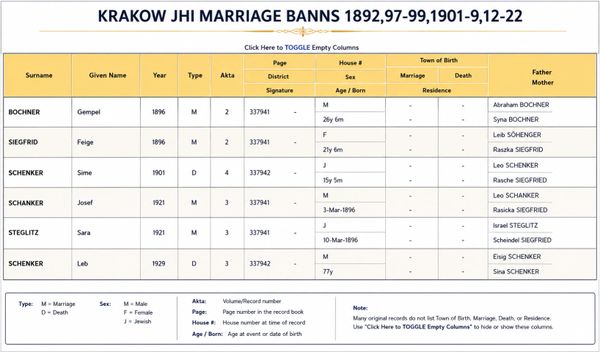
IMPORTANT: Judlowa records show Isaac and Sima Schenker as the parents of Leib Schenker. Leib Schenker was the brother of Cipporah Schenker--Jehudah MANSBACH's wife and the father of Oyser. Thus, Isaac and Sima Schenker were Robert's great-great grandparents.
When Cipporah MANSBACH passed away in 1897 she left six children: Oyser (later Abraham, later Isidore, later Irving) MANSBACH; Israel HILLEL MANSBACH; Izzy MANSBACH, Sima MANSBACH (later Sadie Orner, married to Sam Orner with one child), Feiga MANSBACH (later Feiga Siegfried), and Pinchas Elimelech MANSBACH. All of Jehudah's children with Cipporah, except for Pinchas and Feiga, emigrated to the United States around the turn of the century. Feiga perished in the Shoah.

Around 1900, Jehudah MANSBACH married a second time to Malka Fenichel. Jehudah had a number of children with Malka Fenichel: Cyrla MANSBUCH later Schuman, born in 1906; Lea MANSBACH, later emigrated to the U.S. and, after marriage to Sam, known as Lena Leibowitz; and Hana MANSBUCH (later Wallach), who may have come to the U.S. (calling herself Hana MANBASCH and later Lena Rubinson) or perished in the Holocaust; as well as a son by Malka named Isaac MANSBACH who passed away in Poland around 1920.
After the war, the family of Jehudah Mansbach filed a claim for reparations for the property that was owned by family members that perished in the Holocaust. The claim was unsubstantiated and it was denied.

Judlowa’s school records show that Jehudah sometimes took the name Joel and “Jech[iel]. We also see that Pinkas [Elimelech] MANSBACH, the eldest son of Jehudah MANSBACH, had a school age child named Cyporah and was married to a woman named Lieba Spett. Schenker is confirmed as the maiden name of Cyporah, the first wife of Jehudah MANSBACH. Jehudah's children with his second wife, Malka, are listed as well.
Oyzer MANSBACH, Robert's grandfather in school in Judlowa c. 1905, six lines from the bottom.

Oyzer Ha Levy Mansbach 1890-1965 (known as Abe/Irving in the US)
The youngest son of Jehudah HaLevy MANSBACH and Cipporah MANSBACH was Oyzer Ha Levy MANSBACH, Robert MANSBACH's grandfather:
1. Oyzer HaLevy MANSBACH was born on July 1, 1890; his mother (Cipporah) died when he was just seven years old. In 1904, when he was 14, Oyser, along with his brother Israel Hillel MANSBACH, made there way somehow from Judlowa to Glasgow, Scotland where they boarded the S.S. Ethiopia and sailed to the U.S. They arrived on Christmas Eve. Ellis Island Passenger Records identify Oyzer as “Uscher MANSBACK” occupation: “tailor.” According to the ship’s manifest, the brothers had five dollars between them. But Oyzer was also carrying something else: a silver Kiddush cup dated 1886. It’s been passed down in our family ever since. How could his father Jehudah, the keeper of chickens and sometime glazier, afford a silver Kiddush cup? A cup which he then gave to his youngest son to take to America.
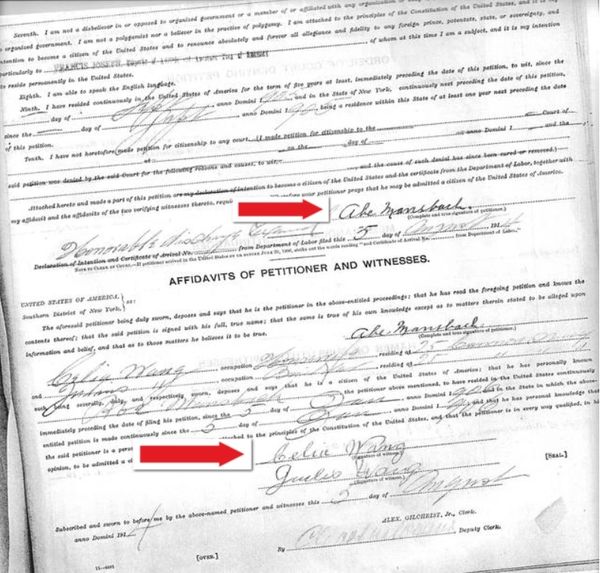
Thus, for example, we know that Celia MANSBACH Wang, a daughter of Moshe Jehudah Mansbach, witnessed the Petition for Naturalization of Oyzer HaLevy MANSBACH, who was the son of Jehudah MANSBACH, the son of Shlomo Peretz MANSBACH. This is the only paper trail, which confirms a family relationship between any of the MANSBACH families. Oyzer certainly did not pick out a random person named MANSBACH to witness these absolutely critical papers; he must have chosen a trustworthy family member to vouch for him. Consequently, Celia MANSBACH Wang from the family of Jacob the Scribe MANSBACH must have been a relative of Oyzer MANSBACH, the first documented evidence that the families of the first Shlomo Peretz MANSBACH and Jacob the Scribe MANSBACH were related—later confirmed by DNA evidence.
THE FOUNDATION DOCUMENT: THE NATURALIZATION PAPERS OF Abe/Oyzer MANSBACH of the Shlomo Peretz MANSBACH family witnessed in Manhattan by Celia MANSBACH Wang, a descendant of the Jacob the Scribe MANSBACH family:

.png/:/cr=t:0%25,l:0%25,w:100%25,h:100%25/rs=w:600,cg:true)


Oyzer and Israel Hillel sailed on the SS Ethiopia. it had three masts rigged for sails in addition to engine power. The ship, made of iron, carried 200 first and second class passengers and 800 (!) in steerage
It is not known what Oyser did for a living after he arrived in New York, no doubt whatever work was available. Life was surely hard. He chose the Army as his best bet which could not have been an easy lifestyle in those days, especially for an observant Jew.
In July 1908, Oyser, described as five feet five and a half inches with brown eyes and hair and a dark complexion, enlisted in the U.S. Army’s 15th Infantry under the name Abe MANSBACH for a three-year period.
Oyzer/Abe in the Army

In 1910, Oyzer, Robert's grandfather, was serving with the Army in Salt Lake City, Utah--3 lines from the bottom:
Oyser, now Abe, re-enlisted in the Army in 1908 (third line from the bottom, above) and served in the Medical Corps in the Hawaiian Islands through July 1914. In the Hawaiian Islands, he served as a pharmacist, although I doubt very much if he could read or write English. He certainly had a very thick Yiddish accent which he carried all the rest of his days. Would you take medicine prepared by this man? Not if you could help it.

Having been discharged from the Army, young Abe attempted to get a job as a conductor on a New York City train line. Apparently, while Abe was in the Army, he got himself into trouble on several occasions.

Bertha Rosenberg MANSBACH wife of Oyzer MANSBACH and Robert MANSBACH's grandmother.:


Lev Rosenberg, Bertha and Breindel--Bertha's parents and Robert's great-grandparents, taken circa 1900 in Eastern Europe.

See fifth line from the bottom for the Rosenbergs.


In 1904, Bertha Rosenberg above married Oyser (then Abraham) MANSBACH. They lived on the lower East Side of Manhattan.

Because of his earlier military service, Oyser/Abe did not have to fight in World War I.